

8 min read · collector guide
Baseball Card Price Guide: How to Value Your Collection
Baseball cards are among the most historically significant collectibles in American culture, with values driven by player legacy, card condition, and scarcity. From a T206 Honus Wagner to a 2011 Topps Update Mike Trout rookie, this guide covers how to value any baseball card.
AI summary
This guide explains how to estimate baseball card value using player significance, rookie status, set year, parallels, autographs, condition, grading, and recent sold comps.
PriceSnap is a mobile app for iOS and Android.
Use the app while reading this guide to scan items, estimate resale value, check marketplace comp signals, and save finds to your collection.
Key takeaways
- Baseball card value depends on player, year, set, rarity, condition, and whether it is a rookie or parallel.
- Vintage and modern baseball cards need different pricing signals.
- PSA, SGC, and BGS grades can heavily affect resale value.
- PriceSnap can scan baseball cards and help users start with a fast market value estimate.
Try alongside this guide — scan straight from your camera roll.
Vintage Baseball Cards (Pre-1980)
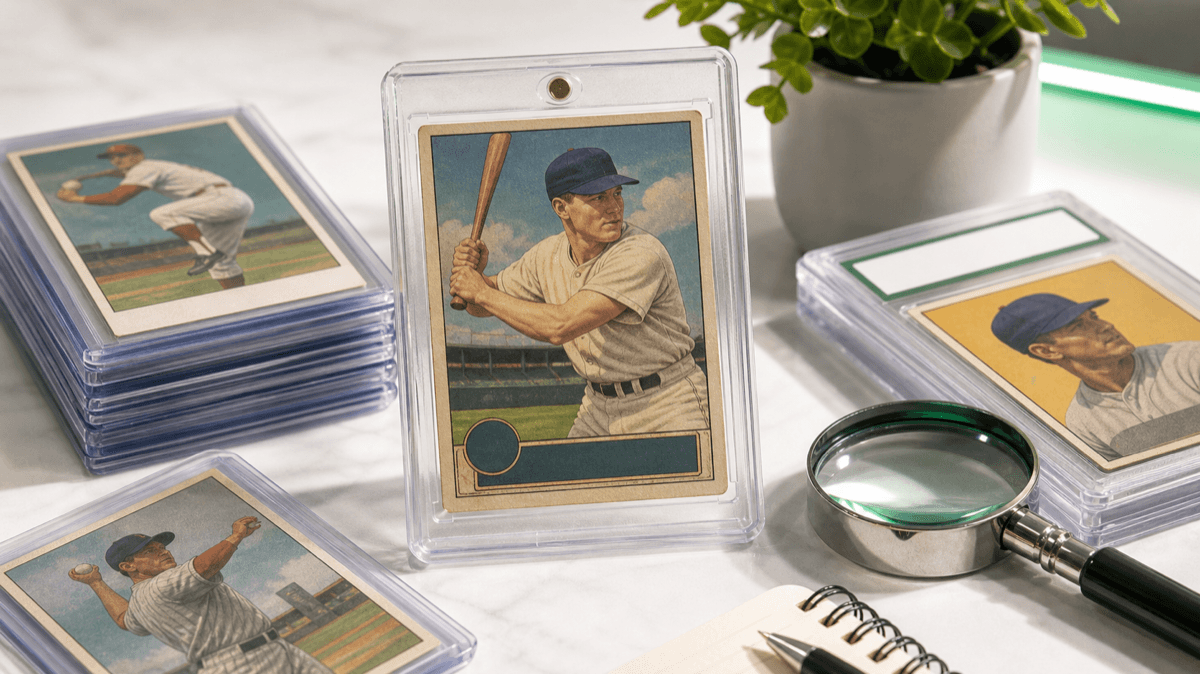
Pre-1980 baseball cards — particularly from the T206 tobacco era (1909-1911), the 1952 Topps set, and the 1969-1975 Topps years — are the most historically valuable. Key factors: scarcity (many vintage cards were thrown away), player significance (Hall of Famers command huge premiums), and condition (pre-1980 cards in PSA 7+ condition are genuinely rare). The 1952 Topps Mickey Mantle (#311) is the most iconic post-war card.
Rookie Cards and Their Value
A player's official rookie card (RC) is typically their most valuable card. For modern players, there are often multiple "official" rookie cards from different brands. Mike Trout's 2011 Topps Update rookie (#US175) is the benchmark modern RC. A player's RC value rises and falls with their career performance — career milestones, awards, and Hall of Fame eligibility all drive price movements.
Understanding Modern Card Parallels
Modern baseball cards (2000s–present) have complex parallel structures. A base Topps card might have a blue parallel (/150), gold parallel (/50), red parallel (/10), black parallel (/5), and a 1/1 superfractor. Rarer parallels are worth significantly more — a superfractor of a top player can sell for thousands while the base card sells for cents.
Autographs and Relic Cards
On-card autographs — where the player signs directly on the card — are worth significantly more than sticker autos, where a sticker is applied to the card. Relic cards containing game-used memorabilia (jersey, bat, base) add collectibility. Multi-player autograph cards and logoman relics (1/1 cards with a player's logo patch) represent the pinnacle of modern card collecting.
Grading Companies for Baseball Cards
PSA dominates baseball card grading, with a PSA 10 premium of 3–10x compared to ungraded Near Mint copies for most vintage and modern cards. SGC grading is preferred by some vintage collectors. Beckett (BGS) offers sub-grades (centering, corners, edges, surface) that provide more detail but are generally less liquid at resale than PSA-graded copies.
Related categories
FAQ
Baseball Card Price Guide: How to Value Your Collection — FAQ
Straight answers about accuracy, platforms, and how PriceSnap fits your workflow.
How do I value a baseball card?
Identify the player, year, brand, card number, rookie status, parallel or autograph details, and condition, then compare recent sold comps.
Can PriceSnap scan baseball cards?
Yes. PriceSnap can scan a baseball card photo and return a directional price range based on card identity and market signals.
Are rookie cards always valuable?
No. Rookie cards are usually more desirable, but value still depends on player demand, scarcity, condition, grade, and recent sales.
Does grading affect baseball card prices?
Yes. A high PSA, SGC, or BGS grade can multiply the resale value of many vintage and modern baseball cards.