

7 min read · collector guide
Coin Value Guide: How to Find Out What Your Coins Are Worth
Coin collecting (numismatics) is one of the oldest hobbies, and valuable coins can hide in plain sight — in coin jars, old rolls, and inherited collections. This guide covers how to determine what your coins are worth, from reading mint marks to identifying error coins.
AI summary
This guide explains how to estimate coin value using date, mint mark, denomination, condition, metal content, error varieties, price guides, and sold auction comps.
PriceSnap is a mobile app for iOS and Android.
Use the app while reading this guide to scan items, estimate resale value, check marketplace comp signals, and save finds to your collection.
Key takeaways
- Date, mint mark, denomination, and condition are the core inputs for coin value.
- Metal content sets a floor for many silver and gold coins, but rarity can add large premiums.
- Error coins and key dates require careful identification before pricing.
- PriceSnap can scan coins and provide a starting estimate before deeper numismatic research.
Try alongside this guide — scan straight from your camera roll.
Reading a Coin: Date, Mint Mark, and Denomination
Three pieces of information determine any US coin's potential value: the date, mint mark, and denomination. Mint marks identify where the coin was made — "S" for San Francisco, "D" for Denver, "CC" for Carson City, no mark for Philadelphia (on most coins). Certain date-mint mark combinations are dramatically rarer than others: the 1909-S VDB Lincoln cent (San Francisco, designer's initials on reverse) is worth hundreds of dollars vs. a few cents for a common 1960 cent.
Coin Grading Basics
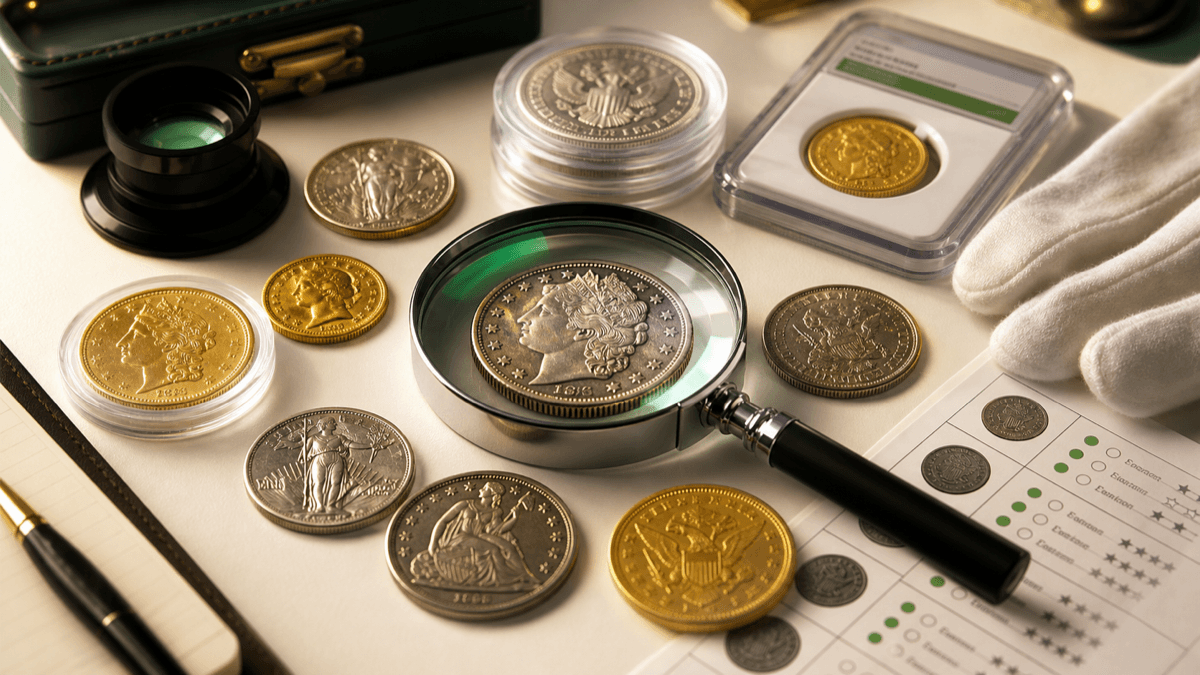
The Sheldon grading scale runs from P-1 (Poor) to MS-70 (Mint State, perfect). Key grades: AG-3 (About Good), G-4 (Good), VG-8 (Very Good), F-12 (Fine), VF-20 (Very Fine), EF-40 (Extremely Fine), AU-50 (About Uncirculated), MS-60–70 (Mint State). The jump from AU-58 to MS-60 and from MS-63 to MS-65 represents the largest value increases. A Morgan Dollar in AU-55 might be worth $40; the same date in MS-65 could be worth $5,000.
Error Coins and Varieties
Error coins — coins with striking mistakes — can be worth substantial premiums. Common errors: doubled dies (where date or text appears doubled due to a misaligned hub), off-center strikes (the coin blank wasn't centered when struck), clipped planchets (a curved or straight clip missing from the edge), and wrong-metal errors. The 1955 DDO (Doubled Die Obverse) Lincoln cent is a famous valuable variety. PriceSnap's AI flags likely error coins for further identification.
Silver and Gold Coins
Many pre-1965 US coins contain silver (90% silver dimes, quarters, half-dollars, and dollars; 40% silver Kennedy halves 1965–1970). These "junk silver" coins have a minimum value equal to their melt value based on current silver spot price. Key dates within silver coin series (1916-D Mercury Dime, 1893-S Morgan Dollar) are worth premiums above melt. US gold coins (pre-1933) carry both numismatic and gold value.
Tools for Coin Valuation
For quick valuations, PriceSnap's AI reads the date, mint mark, and condition from a clear photo to return current market values. For deeper research, the NGC and PCGS price guides are the industry standard references. The Red Book (A Guide Book of United States Coins by Yeoman) is the classic annual reference. For rare or key-date coins, PCGS or NGC certification is strongly recommended before selling.
Related categories
FAQ
Coin Value Guide: How to Find Out What Your Coins Are Worth — FAQ
Straight answers about accuracy, platforms, and how PriceSnap fits your workflow.
How do I find the value of an old coin?
Read the date, mint mark, denomination, and condition, then compare price guides and recent sold listings for the same coin.
Can PriceSnap scan coins?
Yes. PriceSnap can scan clear coin photos and return a directional value estimate based on visible details and market signals.
What makes a coin valuable?
Rare dates, mint marks, low mintage, errors, metal content, historical demand, and high grades can all increase coin value.
Should rare coins be professionally graded?
Rare, high-value, or key-date coins should usually be authenticated and graded by PCGS or NGC before sale.